
How to Stop a Dog From Barking: 7 Methods That Actually Work
Excessive barking always has a cause. Here's how to find yours and fix it — seven trainer-tested methods, plus what to try when nothing else works.

Barking is not a behaviour problem. It is communication — the canine equivalent of talking. The problem is never that your dog barks; it is that the barking has become constant, misdirected, or aimed at the wrong things.
Which means the fix never starts with "how do I make it stop." It starts with why is it happening — because the seven causes below each need a different response, and using the wrong one usually makes the barking worse.
First, identify the type of barking
Watch your dog for a day and note when the barking happens. Nearly every case falls into one of these:
| Type | What it looks like | What it means |
|---|---|---|
| Alert | Sharp, repetitive, at windows or doors | "Something is out there" |
| Demand | Directed at you, often with eye contact | "Give me the thing" |
| Boredom | Rhythmic, aimless, often when alone | "I have nothing to do" |
| Fear | Backing away, stiff body, low growl mixed in | "Stay away from me" |
| Greeting | Whole-body wiggle, tail high | "You're home!" |
| Frustration | At the leash, gate, or fence | "Let me get to it" |
| Separation | Starts within minutes of you leaving | "I can't cope alone" |
Getting this wrong is the single most common reason training fails. Ignoring a demand bark works. Ignoring a fear bark teaches your dog that nobody is coming when they are frightened.
1. Remove the trigger before you train the dog
The fastest wins come from changing the environment, not the dog.
If your dog barks at people passing the window, close the blinds or apply frosted film to the lower half of the glass. If they bark at sounds in the hallway, leave a radio or white-noise machine on. This is not cheating — every bark your dog does not rehearse is one they do not get better at.
Environmental management alone resolves a surprising share of alert barking. Start here, then train.
2. Teach an incompatible behaviour
A dog cannot bark and hold a toy at the same time. They cannot bark at the window and lie on a mat across the room simultaneously.
Pick the behaviour you want and reward it heavily:
- "Go to your place" — send them to a mat when the doorbell rings
- "Find it" — scatter treats on the floor, which puts the nose down and the head quiet
- Fetch a toy — gives the mouth a job on arrival
The trick is to practise this when your dog is calm, long before the trigger appears. A cue that has never been rehearsed will not work the first time it is genuinely needed.
3. Stop rewarding the bark by accident
Demand barking survives because it works. Your dog barks, you look up, speak to them, move the food bowl, or open the door — and the behaviour just got paid.
Two rules:
- Wait for silence before anything happens. Even two seconds counts at first.
- Reward the quiet, not the pause between barks. Timing matters more than the size of the treat.
Expect it to get worse before it gets better. When a behaviour that used to work stops working, dogs try harder first — an extinction burst. Holding the line through that week is the whole job.
4. Meet the exercise and enrichment quota
A bored dog barks because barking is the most interesting thing available. Physical exercise helps, but mental work tires dogs faster:
- Feed at least one meal from a puzzle feeder or scattered in the grass
- Ten minutes of nose work beats thirty minutes of fetch for settling a dog
- Rotate toys weekly so they stay novel
If barking spikes on days you skip the walk, you have your answer.
5. Use a calm interruption, never a shout
Shouting at a barking dog sounds like barking back. To your dog, you just joined in.
A neutral interrupter — a soft sound that redirects attention without frightening — works better. The moment your dog stops to look, mark it ("yes!") and reward. You are not punishing the bark; you are creating a gap of silence you can pay for.
This is what the ultrasonic Bark Button in Paw Plan does. Dogs hear up to roughly 45 000 Hz; most adults stop hearing above 15 000 Hz. A tone at around 15 500 Hz is therefore a clear signal to your dog and close to silence for you — you interrupt the dog without disrupting the room.
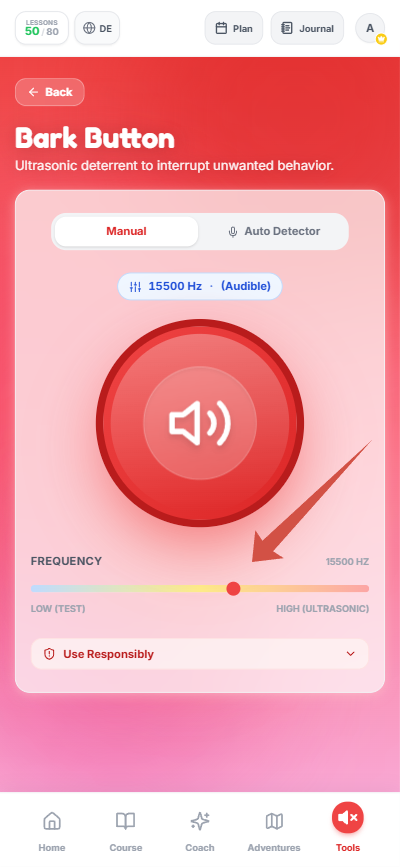
Manual mode: you play the tone the moment barking starts, then redirect.
Three rules make the difference between an interruption and harassment:
- Keep each tone between 1 and 3 seconds. Under a second most dogs don't register it; over three you have crossed into nagging.
- Always follow the tone with something to do. The sound buys you about two seconds of attention — spend them on a name, a known cue, and a treat. Without that follow-up the tone teaches nothing.
- Keep sessions to 5–10 minutes and at least a metre of distance. Continuous use stresses the dog and dulls the effect.
One caveat worth knowing: dogs over about ten years old lose high-frequency hearing, so if an older dog stops responding, drop to 10–12 kHz rather than turning the volume up.
6. Never punish fear barking
If the body language is fearful — weight back, ears flat, hard stare, hackles up — punishment makes the underlying emotion worse, even when it silences the sound. You end up with a dog that still feels afraid but no longer warns you first. That is how bites happen without warning.
Fear barking needs distance from the trigger and gradual, positive exposure at a level your dog can handle. If the trigger is people or other dogs, this is worth doing with professional guidance.
The same applies to interrupters, including the Bark Button: fear-based barking — storms, isolation panic, resource guarding — does not respond to a deterrent at all, only to a behaviour plan. If the barking looks panicky rather than reactive, that is a signal to talk to a trainer, not to turn any dial higher.
7. Treat separation barking as its own problem
Barking that starts within minutes of you leaving and continues is not general barking — it is distress. The other six methods will not touch it.
Separation-related behaviour needs a graduated absence protocol: leaving for seconds, then minutes, always returning before your dog panics. It is slow, it is specific, and it has its own guide — separation anxiety, step by step.
Barking that only happens on walks, aimed at other dogs or people, is also its own problem rather than a variant of this one. That is reactivity, it is driven by fear or frustration rather than habit, and the method is distance-based — see leash reactivity.
What not to do
- Anti-bark collars. Shock and citronella collars suppress the symptom and reliably worsen fear-based barking.
- Debarking surgery. Removes the voice, not the reason.
- Waiting it out. Barking is self-reinforcing — every unaddressed session makes the habit stronger.
How long this takes
Most owners see real change in two to three weeks of daily practice. Barking rehearsed for years takes longer, and progress is rarely linear — expect good days and bad ones.
The dogs that improve fastest are the ones whose owners identified the type correctly in week one. Spend the time on that, and the rest follows.
Common questions
- Why does my dog bark at everything?
- Dogs that bark at every sound are usually alert barking — reacting to movement or noise they can detect but not identify. Blocking the view of the street and adding a calm interruption cue resolves most cases within two weeks.
- Should I ignore my dog when they bark?
- Ignoring works for demand barking, where the bark is aimed at getting your attention, food, or play. It does not work for alert, fear, or boredom barking, because those barks are not asking you for anything.
- Do anti-bark collars work?
- Shock and citronella collars suppress the sound without addressing the cause, and they frequently make fear-based barking worse. Positive interruption paired with a trained alternative behaviour is both kinder and more durable.
- How long does it take to stop excessive barking?
- Most owners see meaningful change in two to three weeks of consistent daily practice. Barking that has been rehearsed for years takes longer, and separation-related barking usually needs a dedicated protocol.


