
Separation Anxiety: Helping a Dog Who Can't Be Alone
Whining, chewing, accidents the moment you leave? Here's how to rebuild your dog's confidence step by step — and when to bring in a pro.

There is a specific kind of dread that comes with putting your key in the door and hearing it start again — the scratching, the whining, the neighbour's polite message about the noise. If you have been through it, you already know that the usual advice ("just ignore it", "tire them out first") does not touch it.
That is because separation anxiety is not a training problem in the ordinary sense. It is panic. Your dog is not being stubborn or spiteful while you are gone; they are having something closer to a panic attack, and no amount of correction changes a panic attack. What changes it is teaching the dog, in very small increments, that being alone is survivable.
First: is it actually separation anxiety?
This distinction decides everything you do next, and it is the step most people skip. Boredom and anxiety produce similar-looking destruction and completely different treatment plans.
| Separation anxiety | Boredom or under-exercise | |
|---|---|---|
| When it starts | Within 5–30 minutes of you leaving | Later, often hours in |
| Where the damage is | Doors, windows, exit points | Wherever the fun stuff was |
| Body state | Drooling, panting, pacing, dilated pupils | Relaxed between bouts |
| Before you leave | Distress begins during your keys/coat routine | Nothing unusual |
| Toileting | Accidents even in a house-trained dog | Rare if the schedule fits |
| Eating alone | Refuses food, even a stuffed toy | Eats happily |
The single most useful thing you can do this week costs nothing: record your dog. Set a phone or webcam on a shelf, leave for twenty minutes, and watch it back. Owners are almost always surprised — either by how quickly the panic starts, or by discovering their dog sleeps peacefully and the neighbour was hearing someone else's dog.
If your dog will not touch a favourite chew while alone, that is a strong signal. Anxious animals do not eat.
Why "ignoring it" fails
The advice to ignore the whining comes from demand behaviours, where attention is the reward. That logic is sound for a dog barking at you for a ball — see the types of barking for how to tell those apart. It is wrong here.
A panicking dog is not asking for attention. They are asking whether they have been abandoned, and leaving them in that state longer does not build tolerance — it rehearses the panic. Every long absence a dog spends terrified makes the next one start faster.
The same goes for punishment after the fact. Coming home to a destroyed door and scolding the dog teaches them that your return is unpredictable and frightening, which adds a second problem on top of the first.
The core method: absences below the panic threshold
Everything that works rests on one idea. Find the length of absence your dog handles without distress, and work just under it. Not at it. Under it.
If your dog starts panting at 40 seconds, your training absence is 20 seconds. That feels absurdly slow. It is also the only thing that reliably works, because a dog who panics during a rep has just practised panicking.
Step 1: break the pre-departure cues
Long before your dog is alone, they have read the signs. Keys, shoes, the specific bag, the laptop closing. By the time you reach the door the adrenaline is already up.
Defuse those signals by doing them constantly and going nowhere:
- Pick up your keys, sit back down, watch TV
- Put your coat on, make coffee, take it off
- Open the front door, close it, stay inside
Repeat until they mean nothing. Most dogs need one to two weeks of this scattered through the day, and many owners see a meaningful drop in anxiety from this step alone.
Step 2: build duration in tiny steps
Now practise real absences, starting below threshold:
- Step outside, close the door, come back in immediately. No greeting fuss — calm and boring in both directions.
- Repeat until your dog stops tracking the door.
- Add time in small increments: 5 seconds, 10, 20, 30, a minute.
- Vary the length. Ten seconds, then forty, then five. Predictable escalation teaches your dog to brace; randomness teaches them that the door opening again is the normal outcome.
The rule that governs all of it: if your dog shows distress, your last absence was too long. Drop back to a length they were comfortable with, do a few successful reps, and end there.
Progress is genuinely non-linear. A dog comfortable at fifteen minutes can fall apart at sixteen. That is normal — the curve has steps in it, not a smooth slope.
Step 3: make alone-time worth something
Pair your departures with something good that only appears when you leave: a stuffed frozen feeder, a long-lasting chew, a snuffle mat. This does two jobs — it occupies the first critical minutes, and it slowly shifts the emotional meaning of your coat coming off the hook.
One caveat that saves people weeks of confusion: a dog who refuses the food is telling you the absence is already over threshold. The food is not a fix, it is a thermometer.
What helps around the edges
These do not treat separation anxiety on their own, and anyone selling them as a cure is overselling. As support for a real absence plan, they earn their place:
- A consistent settle spot. One bed, one mat, one corner — used for calm every day, not just when you leave.
- Sound cover. A steady low-frequency soundscape masks the hallway noises and slamming car doors that spike a dog mid-absence. In Paw Plan the Calming tool is built for exactly this: pink-noise-based presets for acute stress, played softly — around 50–60% volume, roughly a metre from your dog, not in their bed. The conditioning only develops if you use the same preset in the same place, so resist switching tracks looking for a better one.
- Real mental work. Ten minutes of nose work settles most dogs more than thirty minutes of fetch, which often leaves them more aroused than when they started.
- Morning exercise before a long absence — a tired dog crosses the threshold a little later, buying your plan some room.
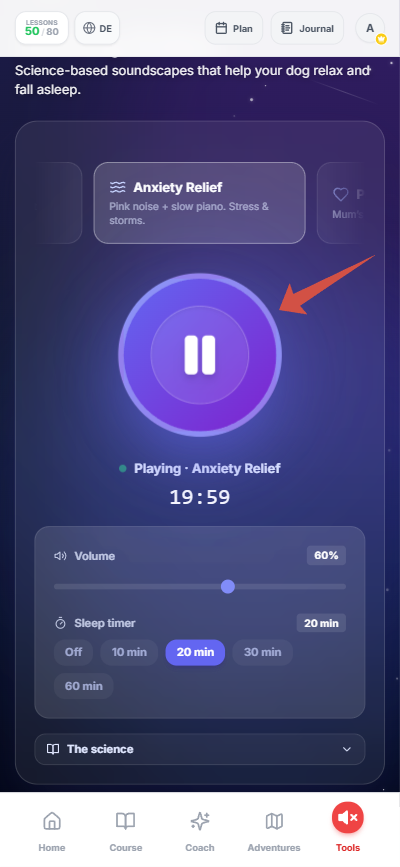
Anxiety Relief preset with the sleep timer running — start it before you leave, not as you walk out the door.
Be clear-eyed about the sound tools in particular: they are a buffer for situational stress, not a treatment for panic. If your dog is drooling, pacing, or destroying the room, a soundscape helps at the margins while the behaviour plan does the actual work.
The part nobody wants to hear
Recovery requires that your dog is not left alone beyond their threshold while you train. Every over-threshold absence undoes days of progress.
For most people that means arranging real coverage during the training period — a sitter, daycare, a neighbour, working from home, taking the dog with you. It is inconvenient and sometimes expensive, and it is also the difference between a plan that works in two months and one that never converges.
If total coverage is impossible, do what you can. Fewer over-threshold absences still beats more of them. Just expect the timeline to stretch.
When to involve a vet or behaviourist
This is one of the behaviour problems where professional help is not a luxury, and the app is not a substitute for it. Talk to a vet or a qualified veterinary behaviourist if:
- Your dog injures themselves trying to escape — broken teeth, bloodied paws, torn nails at the door frame
- The panic starts within seconds of you leaving, or is present even when you are home but out of sight
- There has been no improvement after six to eight weeks of consistent, correctly-executed practice
- Your dog will not eat anything at all in your absence
- The behaviour appeared suddenly in an adult dog with no obvious trigger — sudden onset can be pain or cognitive decline, not anxiety
- You are burning out, or the household is at breaking point
On medication: for severe cases, short-term anti-anxiety medication prescribed by a vet is often what makes behaviour work possible at all — it lowers the baseline enough that the dog can actually learn. It is not a failure of training or a shortcut, and it is a conversation to have with a vet rather than a decision to make from an article.
Sudden-onset cases deserve particular emphasis. A dog who was fine alone for six years and is suddenly not fine needs a physical exam before a behaviour plan. Pain and age-related cognitive change both present this way.
A realistic timeline
Mild cases — the dog who whines for ten minutes then settles — often resolve in four to eight weeks. Established panic, especially in rescue dogs with a history of being rehomed, commonly takes three to six months of daily work.
What that work looks like day to day is unglamorous: a few minutes of departure practice, a few doorway reps, a stuffed feeder, and the discipline to stop before your dog is uncomfortable. It is closer to physiotherapy than to obedience training — small, repeated, and cumulative.
The dogs who recover fastest belong to the owners who resisted the urge to test the limit. If you take one thing from this: when in doubt, make the absence shorter. You are not losing time. Under threshold is where all the learning happens.
That same threshold principle drives the other big fear-based problem owners face — leash reactivity, where distance replaces duration as the dial. And if the damage you come home to is the main symptom, it is worth checking it against the other causes in destructive chewing before assuming separation is the driver.
Common questions
- How do I know if it's separation anxiety or just boredom?
- Timing and intensity. Anxiety starts within the first 5–30 minutes of you leaving, peaks early, and looks like panic — pacing, drooling, damage concentrated at exits. Boredom starts later, is spread across the day, and the damage is recreational: a shoe, a cushion, whatever was reachable.
- Should I get a second dog to keep my dog company?
- Usually not. Separation anxiety is almost always attachment to a person, not a general dislike of being alone, so a second dog rarely helps and occasionally teaches the new dog to panic too. Never take on a second dog as a treatment plan.
- How long does it take to fix separation anxiety?
- Mild cases often improve within four to eight weeks of daily practice. Established panic frequently takes three to six months, and progress is not linear — plateaus and setbacks are part of a normal recovery, not evidence the plan failed.
- Does crate training help with separation anxiety?
- For some dogs a crate is a safe den; for a genuinely panicked dog it is a trap, and confinement can escalate the panic into self-injury — broken teeth and torn nails from trying to escape. Test the crate while you are home before ever using it for absences.


